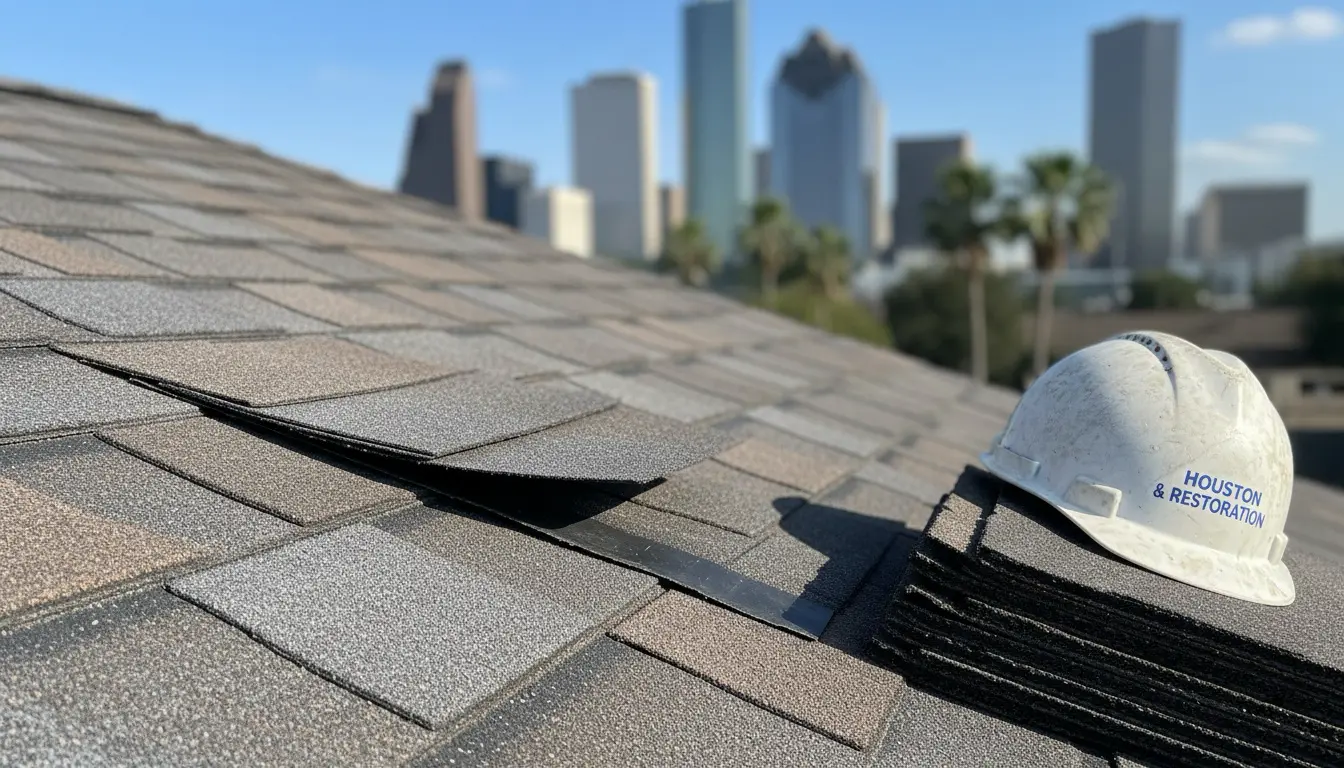
Houston averages more lightning strikes per square mile than nearly any other US metro — the Gulf Coast generates them by the thousands every storm season. Most strikes don’t hit homes. The ones that do can leave hidden structural and fire damage that takes a careful inspection to find.
Lightning struck your home? Call the fire department first — even with no visible flames. Lightning ignites attic insulation in ways that smolder for hours. Then call us for full structural inspection. Standard Texas HO-3 policies cover lightning damage to roof, attic, and electronics.
Lightning is one of the few damage events where there’s a strict order of operations — safety steps first, repair conversation second.
1. Call the fire department, even with no visible flames. Lightning ignites attic insulation and wood framing in ways that smolder for hours before catching. The fire department arrives with thermal imaging cameras and will scan the attic, walls, and roof structure for hot spots. This is the single most important step. Do it before anything else.
2. Don’t use electrical devices until checked. Lightning can damage panel breakers, GFCI circuits, and ground systems in ways that aren’t obvious. If anything in the home smells hot, looks scorched, or won’t turn on/off normally, leave it alone and call an electrician.
3. Document with timestamped photos. Photograph the strike point on the roof from below, the attic, any visible damage inside, any electronic devices that died. Time-stamped phone photos are perfect.
4. Then call us. Once the fire department clears the home, we come out for a full structural inspection — roof, attic, framing, decking, fasteners. Same-day during business hours.
A clean direct strike on a roof leaves a small visible mark and a much larger hidden problem. Here’s the typical full scope.
Scorched shingles in a 1-3 foot radius, sometimes a punctured hole through the decking. Often a starburst pattern where the bolt’s shockwave radiated outward.
Typical: 1-2 squares + decking sheet
Lightning current travels through the path of least resistance — often the metal in nails, vents, or any HVAC penetration. Cracked rafters near the strike, splayed nails that backed out, separated truss plates.
If found: sister rafters, re-fasten decking, structural review
The most dangerous hidden damage. Heat from the strike can ignite blown-in insulation in pockets that smolder for hours. The fire department’s thermal scan finds it; we replace any heat-affected insulation as part of the repair.
Typical: partial attic insulation replacement
Surge from a strike often damages the main panel, breakers, GFCI outlets, and any electronics that were on the affected circuit. An electrician needs to scope this part. Reimbursable under the same homeowner’s claim.
Electrician scope, separate from roof scope
Lightning is a named peril. Standard Texas HO-3 policies cover lightning damage explicitly — both the roof and any internal damage from the same strike. There’s no “wind/hail vs. all-perils” debate. Your standard all-perils deductible applies, typically $1,000-$2,500.
One claim, multiple scopes. A single lightning strike can produce a roof scope, an interior drywall scope, an electrical scope, and an electronics scope. They’re all on the same claim. Your insurer will assign one adjuster who reviews all of it. We handle the roof and structural part.
Hidden damage discovery. The first scope rarely catches everything. We expect supplements on lightning claims as additional damage surfaces during repair — cracked decking found when we open the strike point, framing damage discovered when we pull insulation. Supplements are normal and routine.
Direct strikes leave clear evidence: scorching at the impact point, a hole or split in shingles and decking, sometimes a starburst pattern of broken shingles. Indirect strikes are harder — you may see no visible roof damage but find electrical damage inside the home, melted attic wiring, or fire smolder evidence in the attic insulation.
Yes, every time. Lightning can ignite attic insulation or wood framing in ways that smolder for hours before flaring. The fire department will check with thermal imaging. This is non-negotiable — do this before you call us.
Lightning is a named peril in standard Texas HO-3 policies, so yes — covered for both roof damage and any electrical/electronic damage inside. The all-perils deductible applies, not the wind/hail deductible.
This is the part most adjusters underscope. Lightning current passing through the framing can crack rafters, split trusses, and damage fasteners well away from the visible strike point. We always inspect the full attic with a structural eye, not just the obvious entry hole.
Always. Even when the visible damage looks minor, lightning can damage panel components, breakers, and grounding systems. An electrician’s inspection catches what we don’t see — and the cost is typically reimbursable under the same insurance claim.
Sometimes a patch is all that’s needed — if the strike is small, the decking is intact, and adjacent shingles are sealed. More often we find structural damage to the decking or framing that requires a section replacement. We won’t patch over compromised structure.
Full structural inspection. Insurance claim representation. Coordinated scope with electricians and drywall.
Three fields. Real human, every time. No bots. We answer fast because the roof can't wait.
Three fields. We'll get back to you.