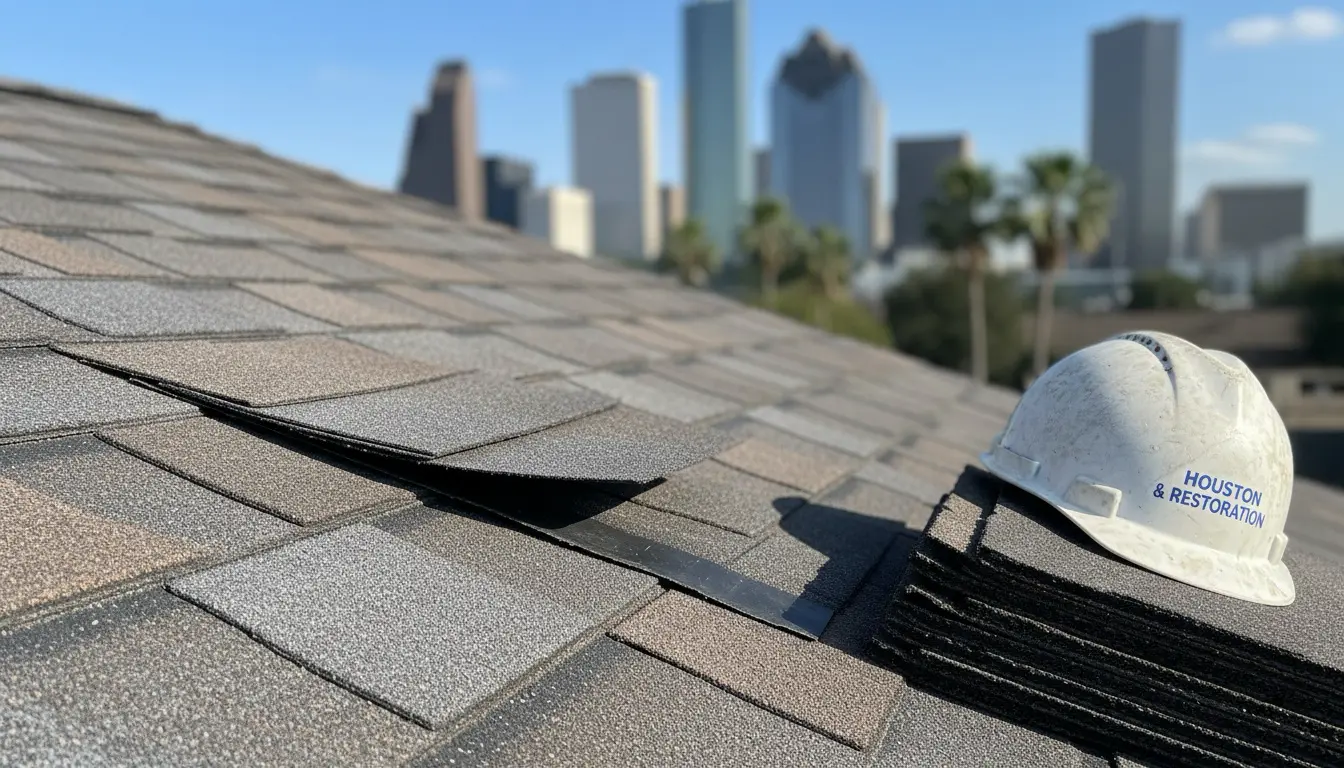
What a representative Cinco Ranch hail claim recovery actually looks like — adjuster meeting, supplement filing, depreciation recovery, and the upgrade math that turns a storm into a 25-year roof. Real ranges, real process.
The typical Katy hail claim candidate is a 1990s-2010s master-planned home in Cinco Ranch, Cross Creek Ranch, Falcon Point, or Grand Lakes with original architectural asphalt shingles in their second decade. A major Houston hail event (2017, 2021, or 2024) has caused legitimate damage. The homeowner files a claim. The adjuster comes back with a low scope or partial denial citing “cosmetic damage only” or “wear and tear.”
This is where most Katy claims need supplements. The initial scope often misses damaged decking, code-required ventilation upgrades, ice-and-water shield, and damaged accessories like gutters and downspouts. Drone documentation is the difference-maker. High-resolution overhead photos make it harder for adjusters to dispute damage they can clearly see.
The bigger opportunity: Class 4 impact-rated upgrade. Most Texas insurers approve the upgrade as part of the claim, with the homeowner paying only the small material premium. The upgrade reduces future hail damage risk and triggers a 15-28% premium discount going forward.
Active leaks tarped same-day or next-morning. Drone imagery captured before tarping to preserve storm-day damage evidence — the most important documentation in the entire claim.
Homeowner contacts insurer to file claim. Claim number assigned. We schedule the adjuster meeting for week 1 or 2.
We meet the adjuster on the roof with drone imagery and a written parallel scope. We walk the damage together — pointing out impact patterns, granule loss, mat fractures, damaged accessories, code-required upgrades.
Most carriers’ adjusters are professional and fair when good documentation is presented. Disputes get resolved on-site. Without a roofer present, the adjuster writes the scope alone — and the homeowner often discovers items missing only after work begins.
The carrier issues an initial scope of work. We compare it line-by-line against our parallel scope. Most Katy claims need at least one supplement — items typically added include damaged decking, ventilation upgrades, ice-and-water shield, drip edge, ridge cap, starter strip, or damaged accessories.
Supplement submitted with photographic evidence and code citations. Most are approved within 1-2 weeks.
For Cinco Ranch, Cross Creek Ranch, Grand Lakes, and other master-planned subdivisions, HOA architectural review is required for shingle replacement. We submit pre-cleared samples to the architectural review committee. 3-7 day approval typical.
Materials ordered, project scheduled. Class 4 impact-rated upgrade discussed with homeowner — small material premium ($1-2/sq ft) for significant insurance discount and future storm protection.
Typical Katy roof: 2-3 days on site. Day 1: tear-off, decking inspection, decking replacement, underlayment install. Day 2: shingle install, ridge cap, flashing. Day 3: cleanup, magnetic nail sweep, walkthrough.
Daily texted updates from project manager. Homeowner can drop by anytime. Final walkthrough confirms scope completion before final payment.
Most Texas policies pay actual cash value (ACV) initially, holding back the depreciation portion of the claim until work is completed. Once the project finishes, we file the recoverable depreciation paperwork with photographic evidence of completion.
Depreciation typically arrives 2-4 weeks after submission. Total claim value of $18-25K typical for a Katy hail claim with Class 4 upgrade — most of which is paid by the carrier minus the wind/hail deductible.
The economics of Class 4 upgrades during hail claims. When the carrier is already paying $14-28K for a roof replacement, the marginal cost of upgrading to Class 4 ($3-6K extra) is small. Some carriers pay the full upgrade as part of code-required improvement; some require homeowner contribution. Either way, the homeowner pays at most a few thousand dollars for an upgrade that pays back through premium discounts in 3-5 years and improves future storm survivability.
Variability matters. Claim size depends on roof size, damage extent, deductible, and carrier. Some Katy claims close at $10K (small home, partial damage); some exceed $40K (large estate, multiple supplements, code upgrades). The pattern of supplements and depreciation recovery is consistent.
What we don’t do. We don’t inflate scopes to maximize insurance payouts. We don’t offer to waive deductibles (insurance fraud). We don’t skip permits or HOA approvals. The claim represents the actual cost of the actual work — no more.
Step 1: Free post-storm inspection. We come out, drone-image the roof, and tell you honestly whether you have a real claim. If damage is below your deductible, we say so. If it’s worth filing, we help you file.
Step 2: Document and file. File your claim with the carrier directly. Reference the drone imagery and our written observations.
Step 3: Adjuster meeting. We attend the meeting with you. Free service — we don’t charge for claim representation; we recover the cost through the project.
Step 4: Project execution. 2-3 days on site. Daily updates. Final walkthrough.
Step 5: Depreciation recovery. We file the recoverable depreciation paperwork once work completes. 2-4 week typical recovery.
If you have a Katy storm claim that’s been undercount or denied, we can typically reverse the dispute with proper documentation. Katy storm damage overview here.
Three fields. Real human, every time. No bots. We answer fast because the roof can't wait.
Three fields. We'll get back to you.