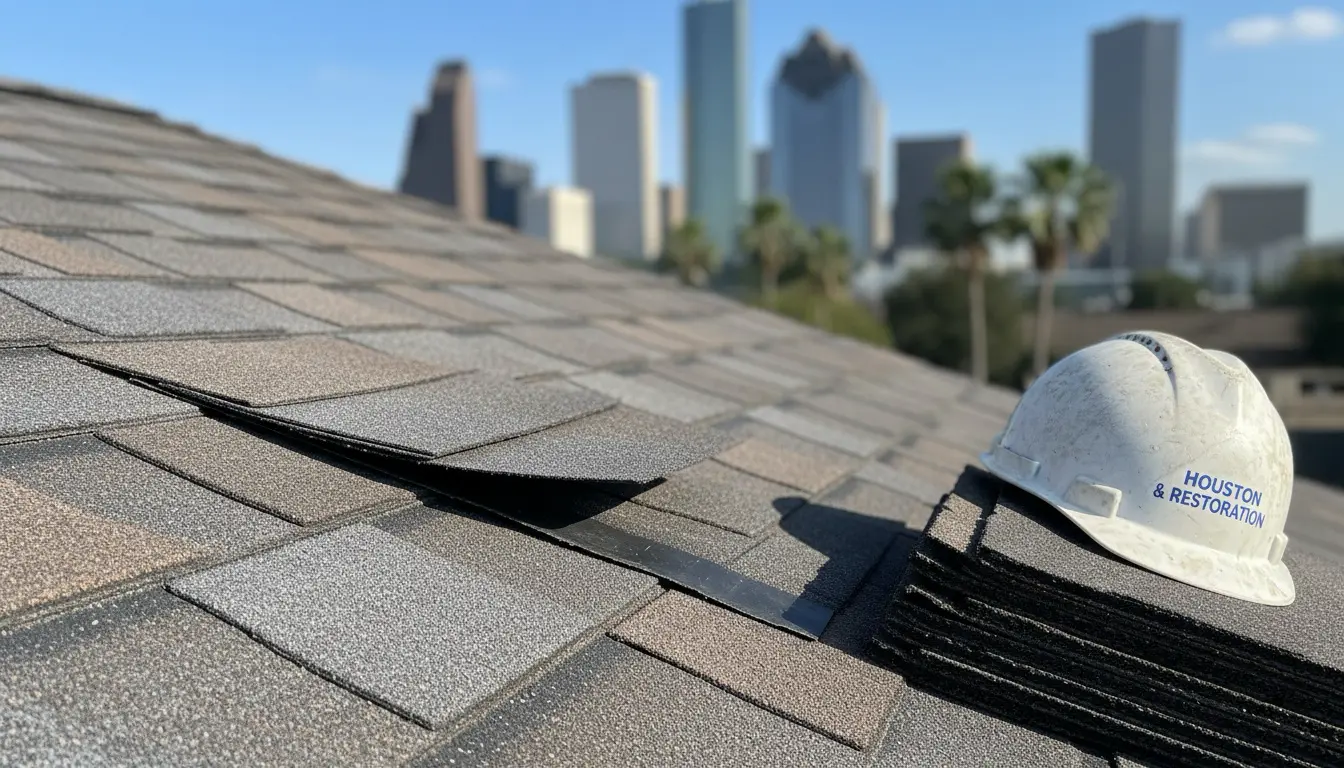
Multi-tenant flat roofs are their own discipline. Shared drains, mixed HVAC, parapet wall details, and tenant operations that can’t be shut down for a week. We scope, phase, and execute strip-center projects with property managers and tenants in mind — not just the roof.
Most strip-center leak calls aren’t about the membrane itself — they’re about the details around the membrane.
Drain clogs and ponding. Number one issue we find. Houston rain produces 2-4 inches per hour during heavy events. If primary drains are blocked by debris, the water has nowhere to go. Ponding water above 24 hours after rain is a code violation in many jurisdictions and shortens membrane life dramatically.
HVAC curb flashings. Every HVAC unit on a roof sits on a curb, and every curb is a flashing transition. Aged curbs leak around the perimeter where the membrane terminates. We see roofs where the membrane is 8 years old and looks fine but the HVAC curbs have failed flashings.
Parapet wall details. The wall around the perimeter of a flat roof. Counterflashing, coping caps, through-wall flashings — all transition points that fail when the membrane below is still good. Common cause of leaks at the back wall of a tenant space.
Tenant penetrations. Restaurant exhaust hoods, refrigeration condenser drains, sign electrical, satellite mounts. Every penetration is a future leak unless properly flashed and sealed. We inventory every penetration during scope and address each one.
Aged caulks and sealants. The 5-7 year invisible problem. Caulks at terminations crack, sealants pull away from substrate, lap sealant on TPO seams degrades. Annual maintenance catches this; deferred maintenance turns it into leaks.
Each has a place. Pick based on existing substrate, building use, budget, and warranty needs.
White reflective membrane, heat-welded seams, mechanically fastened or fully adhered. The Houston default for strip centers and most commercial flat roofs.
Asphalt-based membrane, hot-applied or self-adhered. Strong puncture resistance — better than TPO for high-traffic roofs (HVAC service, multiple tenants accessing).
Spray-applied silicone over an existing roof in serviceable condition. Adds 10-15 years to a roof that’s aging but not failed. Less expensive than tear-off.
Phase planning, not blanket replacement. A 30,000 sq ft strip center reroof breaks into 4-8 sections aligned with tenant boundaries. Each section gets its own start date, work window, and tenant notification. Tenants stay open during their phase if scope allows; closed only if work above their space requires it.
Off-hours work for sensitive tenants. Restaurants, daycare, medical — any tenant where overhead work during operations is a problem — gets night work or weekend work. Standard adder on the project but standard practice on properly run jobs.
Tenant notification protocol. Every tenant gets advance notice of when work starts above their space. We provide property management with the schedule, the scope summary, and a contact for tenant questions. No surprises.
Coordination with HVAC. Tear-off and installation around HVAC units requires coordination. Often we lift, work under, and reset units — or the property’s HVAC contractor handles brief disconnects during membrane work. Either way, scope is documented up-front.
Daily site close-out. Every workday ends with a watertight roof. No tear-off without same-day dry-in. No exposed substrate overnight. This is non-negotiable on tenant-occupied work.
Multi-tenant strip centers have one continuous flat or low-slope roof spanning multiple businesses with shared drains, common parapet walls, and a mix of HVAC and venting penetrations from each tenant. Scope of work has to be coordinated against tenant operations — you can’t just shut down a center to reroof. Phased work, off-hours work, and tenant communication are part of the project.
The three workhorses are TPO (white thermoplastic, reflective, 60-mil typical), modified bitumen (asphalt-based, hot-applied or torch-down), and EPDM (black rubber membrane, less common in Houston). For new installations we typically recommend TPO — reflective for Houston heat, mechanically fastened or fully adhered, 20-25 year warranty paths.
Yes for most repair scope. We work above tenant spaces during business hours when the work is contained — flashing repairs, drain cleaning, partial coatings. Full system replacement requires phased work, off-hours work, or temporary tenant accommodation. We coordinate with property management on scheduling.
Drainage is typically the #1 problem we find. Clogged scuppers, undersized internal drains, ponding water in valleys between HVAC units, secondary overflow drains that have rusted shut. Proper scope on a strip center always includes drain inventory, flow testing, and corrective work where needed.
TPO system over a 20,000 sq ft strip center typically runs $8-$14 per sq ft installed depending on tear-off requirements, HVAC curb work, drainage corrections, and parapet wall scope. Mid-range project: $160K-$280K. Modified bitumen systems run slightly less; full coverage warranties affect price.
20-30 years with proper installation and maintenance. The membrane itself has a 20-25 year manufacturer warranty when installed by a certified contractor. Maintenance program (annual inspection, drain cleaning, seam check) extends life by 5-10 years and protects warranty.
Free property walk. Drain & HVAC curb inventory. Scope and phasing recommendations.
Three fields. Real human, every time. No bots. We answer fast because the roof can't wait.
Three fields. We'll get back to you.