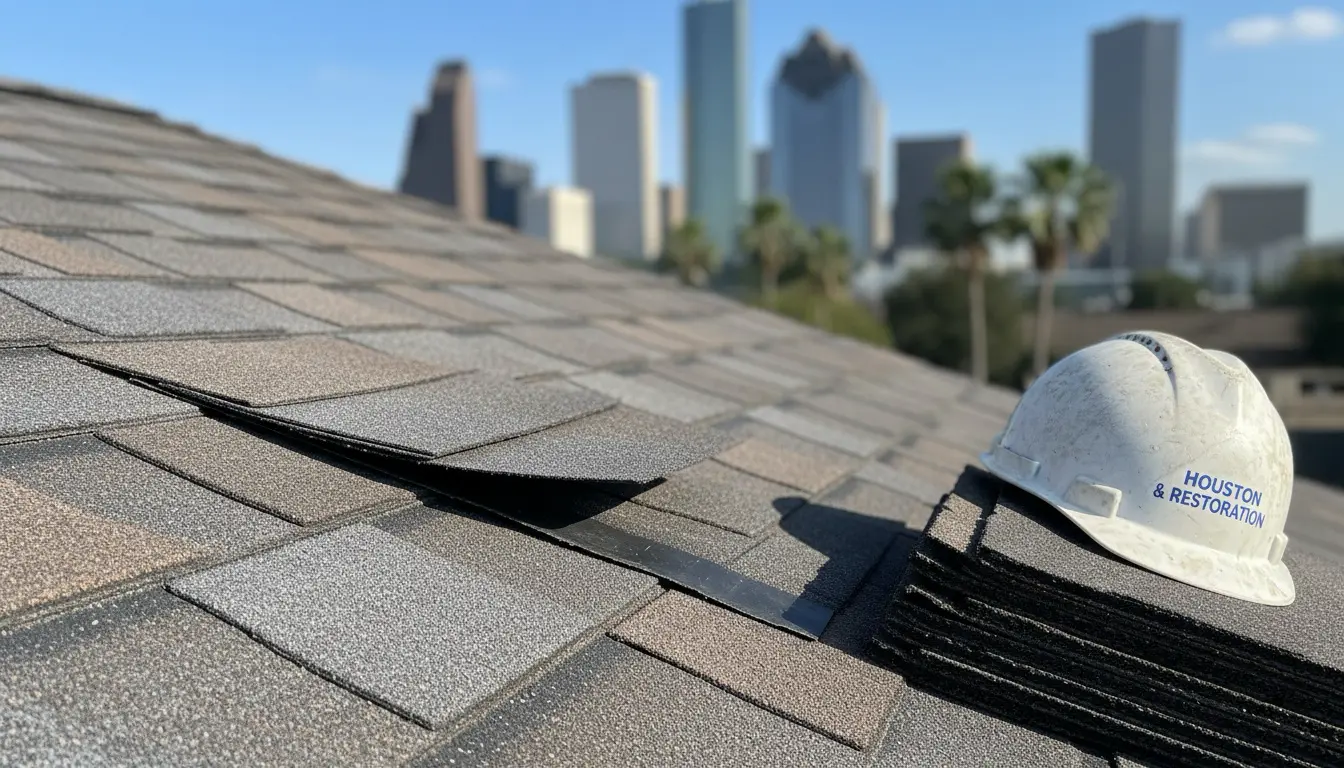
Houston has more old-growth oak and pecan than people realize, and after every major wind event we get the calls. Whether it’s a single limb through the decking or a full trunk across the ridge, the order is the same: stabilize the opening, document the damage, work the insurance claim, then repair properly.
Tree fell on your roof? Call us same-day for emergency tarping. In Texas, your homeowner’s insurance covers your roof damage regardless of whose tree caused it. Standard deductible applies (typically $1,000-$2,500), not the wind/hail percentage deductible.
Step zero is making sure no one is in the affected room. After that, the order matters.
We get to the property the same day during business hours, often within a few hours. The first job isn’t the repair quote — it’s the tarp. An open hole in a Houston roof during the wet season turns a $15K repair into a $40K mold-and-decking nightmare in 72 hours.
Our standard sequence:
The homeowner deals with the tree removal separately — an arborist or tree service handles that part, sometimes with a crane for larger trunks. We coordinate timing but we don’t cut trees.
Beyond the obvious shingle damage at the strike point, here’s what we routinely find on tree-impact jobs in Houston.
Direct impact destroys shingles and usually punches the OSB or plywood decking. Adjacent shingles also lift or crease and have to be replaced even though they look intact — the seal is broken.
Typical scope: 1-3 squares of new shingles + decking sheets
Larger limbs crack rafters or split trusses where they hit. This is the part you can’t see from outside — we inspect from inside the attic with a flashlight, looking for splits, displaced bird’s mouths, and bowed members.
If found: sister-in or full rafter replacement, engineering may apply
Water always finds its way through within hours. Drywall stains, sagging ceiling sections, soaked insulation. Insulation that’s gotten wet doesn’t recover — it has to come out and be replaced.
Typical scope: drywall patch + texture match + paint, attic insulation replacement
The most-missed item in tree-strike scopes. Shingles 4-8 feet around the impact get lifted by the limb’s rebound or by the falling impact wave. They reseat but the seal strip is broken — first windy day they fly. We always inspect a wide perimeter and document.
Often a supplement item after initial scope
Your homeowner’s policy covers your roof. Whether it’s your tree, your neighbor’s tree, or a tree from down the street that traveled in a hurricane — in Texas, your HO-3 policy pays for damage to your insured structures. You don’t chase the neighbor’s policy. Your insurer may pursue them later (subrogation) but that happens behind the scenes and doesn’t involve you.
The deductible is usually the standard one. Tree damage isn’t classified as wind/hail in most policies, so your standard all-other-perils deductible applies — typically $1,000 to $2,500. That’s much better than the wind/hail deductible (often 1-5% of dwelling, which can be $5K-$15K on a Houston home).
Tree removal coverage is limited. Most policies cover $500-$1,500 of tree removal cost, but only when the tree caused damage to a covered structure. If the tree falls in your yard and hits nothing, removal is your cost.
Document fast and document thoroughly. Time-stamped photos of the tree, the damage, and the property condition are the foundation of a successful claim. We do this as part of the inspection. Save them, send them to the adjuster, keep copies.
In Texas, your homeowner’s insurance pays for damage to your roof regardless of whose tree caused it — that’s how the policies are structured. Your insurer may pursue the neighbor’s carrier afterward (subrogation), but you don’t wait for that. File on your own policy.
Exception: if the neighbor was previously notified that the tree was dead or diseased and did nothing, there can be a negligence claim. Document any prior conversations or written notices.
Most Texas HO-3 policies cover tree removal up to a stated limit ($500-$1,500 typical) only when the tree caused damage to a covered structure. If the tree falls in your yard and hits nothing, removal is typically your cost.
For active structural emergencies (tree resting on the home, water entry, exposed framing) we respond same-day during business hours and have an after-hours line for nights and weekends. First step is stabilization — tarp the opening, brace what needs bracing — then full scope inspection.
Yes. The tree comes off first — usually by an arborist or tree service, sometimes by crane for larger trunks. Removing the tree without damaging the roof further is its own skill. We coordinate with tree services we’ve worked with, but the homeowner contracts the tree work directly with their arborist.
Visible roof damage is half the picture. We always inspect the attic for: rafter cracks, broken decking, ceiling moisture stains, displaced insulation, and any fasteners that backed out under impact. A tree strike that looks like ‘just a few shingles’ can hide structural damage to the framing.
Tree damage usually falls under your standard all-other-perils deductible, not the wind/hail deductible. That’s often $1,000-$2,500 instead of 1-5% of your dwelling value. Check your declarations page or call your agent to confirm.
Same-day tarping. Same-week scope. Insurance claim representation included.
Three fields. Real human, every time. No bots. We answer fast because the roof can't wait.
Three fields. We'll get back to you.